
7 Castles You MUST See in France
Did you really click on that clickbaity title? Come on! Really? I guess these cheesy headlines do work! Maybe I should title all my posts like Buzzfeed?
Ha ha, no, I’m just kidding. I would never do that. That’s just terrible. I just wanted to see what happened if I did it. 🙂
But, seriously, let’s talk châteaux (large country houses or castles, plural of château). In June, I went to France
for my birthday to explore the famed Loire Valley, with its rolling
hills, exquisite wineries, wide rivers, and grandiose castles.
This
region of fertile land was the seat of royal power during early French
history. Kings, queens, and other royalty built grand palaces here as
they cemented their rule of this vital trade region. But by the middle
of the 16th century, power shifted to Paris, as kings spent less time
wandering the kingdom and more time there (and who wouldn’t want to
spend more time in Paris?).
However, French royalty still expended
considerable money building beautiful châteaux. The Loire Valley has
over 80, and it would take a lot more of my limited time to see them
all. But I did manage to visit a bunch — and find out ways to do so on
budget! Here are the highlights:
Chambord

This castle is one of the most popular in the region, thanks to its grandeur, detailed façade, intricate decorations, and large gardens. It was original built by Francis I in 1519 as a hunting retreat. However, he died in 1547, and the castle remained half built. It fell into disrepair for nearly 80 years until Louis XIV visited in 1639. He ordered it finished based on the original plans. (Note: This is a running theme for a lot of châteaux in the region.)
Entering
the castle grounds and seeing this massive ornate structure elicited an
audible “wow” from my mouth. I marveled at the building’s intricate
masonry and beautiful spires. The interior’s massive double-helix
staircase inspired by Leonardo da Vinci creates a focal point that draws
your attention as you move through the house. I loved the symmetry of
the large halls and old paintings of royalty.
This place was
gigantic and took hours to see. There are incredible views from the
roof, but my favorite moments were mostly in the gardens, just staring
at every inch of this palace. Truly fit for a king — or at least a
zillion daily tourists!
Tip: I highly recommend
the audio tour. It’s given on an iPad that allows you to zoom in on
paintings and artifacts, provides an overlay of what the room would have
looked in the 17th and 18th centuries (even including images of what it
looked like being built), and gives tons of detailed information. Worth
every euro!
How to get there – You can take a 25 minute shuttle or taxi from the nearby city of Bloise.
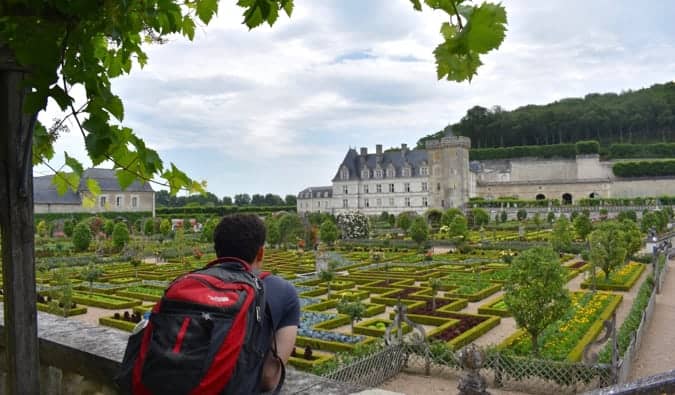
Villandry
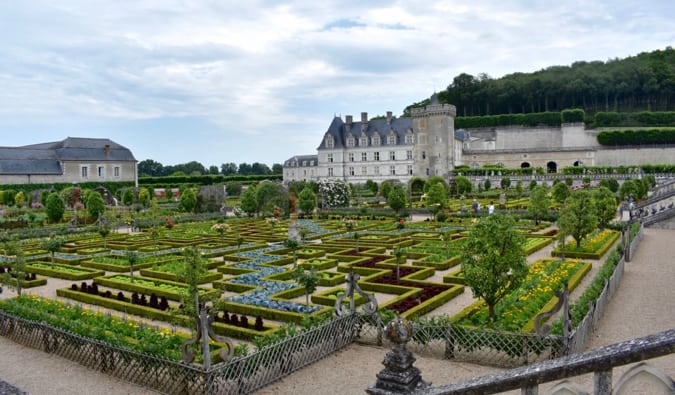
Built into the side of a hill, this château was originally a keep (fortified tower) constructed in the 14th century for King Philip Augustus. When the place was acquired by a local nobleman in the early 16th century, the original keep was preserved, the rest of the structure was razed, and a fortress was erected (with a cool moat!). During the French Revolution, the property was confiscated by the state, and in the early 19th century, Emperor Napoleon gave it to his brother, Jérôme Bonaparte. In 1906, the Carvallo family (the current owners) purchased the property and poured an enormous amount of time and money into it to make it what it is today.
However, despite the grand exterior of
the castle, I found the interior lacking, and I moved through it pretty
quickly. Other than the ornately decorated first rooms, the interior is
very bland (and kind of worth skipping all together).
The main
draw of this château is its famous Renaissance gardens, which include a
water garden, ornamental flower gardens, and vegetable gardens,
altogether containing over 60,000 vegetables and 45,000 bedding plants!
These are laid out in formal, geometric patterns separated with low box
hedges. It’s a beautiful place to wander and relax, with a stream
running through it and many spots to sit and contemplate. There’s also
an adjacent woods with a few trails that not many people wander around,
so you have them all to yourself! Overall, the gardens and woods are the
best part of this castle, and that’s where your time should be spent!
How to get there – There’s a bus from Tours on Wednesday and Saturday. If you go any other day of the week, you’ll need a car.
Blois

Since you have to stop in Blois to see Chambord, the town castle makes an easy addition. Originally a medieval fortress built in the 9th century, it was taken over by Louis XII in 1498 and transformed into a palace in the Gothic style that was a center of power for centuries. (Fun fact: In 1429, Joan of Arc was blessed here before going to fight the British in Orléans.)
There’s not much left of the medieval
fortress. The main part of the castle was built in 1515 by François I in
Renaissance style and includes a famous buttressed circular staircase
leading to the private sleeping rooms and ballrooms.
While this
castle is small and the exterior less ornate than others in the region, I
found the interior to be second to none, with intricately restored
rooms, detailed information plaques, and stunning period furniture.
Outside, you get sweeping views of the town and river. It was a really
lovely castle.
How to get there – From Paris, you can take a two-hour train. From Tours, it’s about 45 minutes.
Amboise
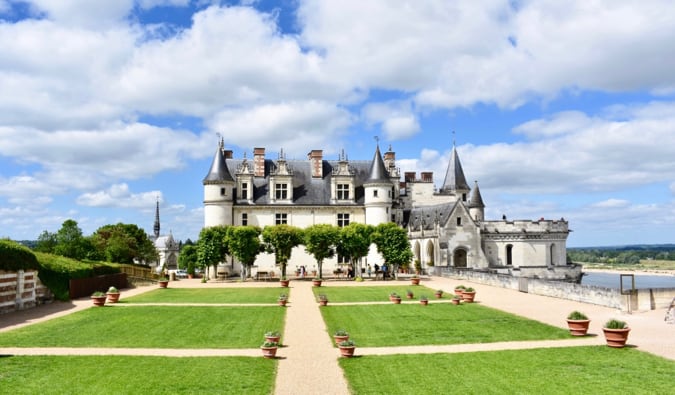
This was my overall favorite castle. It may not be as ornate or large as the others, but it’s the total package: a fairy-tale-like structure with stunning interiors, beautiful gardens, and great views of the Loire River. Confiscated by the monarchy in the 15th century, it became a favored royal residence and was extensively rebuilt by King Charles VIII (who died here in 1498 after hitting his head on a door (seriously)). It was built into a lavish Renaissance palace by his successors but eventually fell into decline in the second half of the 16th century. It was greatly damaged in the French Revolution before being renovated in the 19th century.
That is what I really loved about the palace:
the mix of architectural styles. You had the Gothic portion with its
vaulted roofs, the Renaissance sleeping chambers and exteriors, and the
grandly designed rooms from the 19th century. You can see the mark of
history throughout the palace. I also loved the large, winding carriage
ramp that descended from the castle into the town and the terraced
gardens filled with oak trees. There’s also the church that contains the
remains of Leonardo da Vinci! Really, this place is top-notch!
How to get there – You can take a thirty minute train ride from Tours. The castle is a 10 minute walk from the station.
Clos Luce
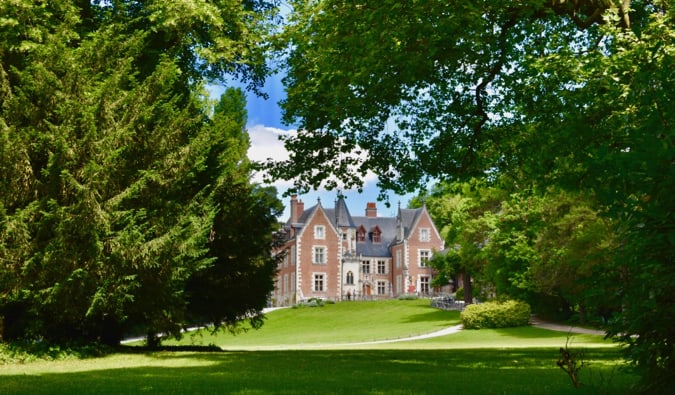
Built by Hugues d’Amboise in the middle of the 15th century, this château was acquired in 1490 by Charles VIII. There aren’t many rooms to explore, but they do retain that Renaissance charm. What makes it famous was that Leonardo da Vinci lived here from 1516 to 1519. Today, the castle is a testament to him, with marvelously restored rooms and a basement filled with replicas of his famous inventions. Additionally, be sure to go outside and look up, as the exterior has tons of Italian influences. The grounds are stunning and contain a restaurant, mill, and several ponds. The extensive gardens, complete with geese, streams, and many walking trails and places to escape and reflect, were an amazing addition, and it’s easy to imagine Leonardo walking around, looking for inspiration.
How to get there – You can take a thirty minute train ride from Tours. The castle is a 30 minute walk from the station.
Azay le Rideau

Originally built in the 12th century, the castle was burned to the ground in 1418 by Charles VII. It remained in ruins until 1518 when it was rebuilt by a local noble. However, the French king Francis I confiscated the unfinished château in 1535 and gave it to one of his knights as a reward for his service, who then left it half built. The castle’s condition deteriorated through the centuries until, in the 1820s, the new owner undertook extensive alteration work to make it the beauty it is today.
A lot of the place was (still) under
construction when I was there, so not all the rooms were open. The
interior was simple and well explained by signs but lacked any ornate
furniture, paintings, or fixtures. This place had my favorite exterior,
though. I loved the square configuration, with its turrets overlooking
the garden; the fact that it’s built on a pond; and the long cobblestone
driveway leading in from town. It’s easy to imagine royalty trotting
down in their carriages to the wrought-iron gates on their way to attend
a ball.
How to get there – You can take a thirty minute train ride from Tours. The castle is a 20 minute walk from the station.
Chenonceau

Chenonceau is one of the best-known châteaux in the Loire Valley. It was built in 1514 on the foundations of an old mill. In 1535, it was seized by King Francis I for unpaid debts. Then in 1547, Henry II gave it as a gift to his mistress, Diane de Poitiers (now one of the most famous women in French history). Diane oversaw the planting of extensive flower and vegetable gardens. In fact, the gardens are still laid out in her original design.
After Henry died, his widow Catherine de’
Medici (also one of the most famous women in French history) forced
Diane out of the castle and made Chenonceau her residence. (Fun fact: In
1560, the first-ever fireworks display seen in France took place here.)
In 1577, she extended the grand gallery across the entire river, making
the château what it is today. After she died, the castle bounced around
various royalty and their mistresses, was luckily spared destruction in
the Revolution, and then was renovated and sold a bunch more times
before it became a state property.
Walking through a forest that
opens up on two gardens (still maintained in their old style), you see
this beautiful, thin castle that spans a river. The interior is quite
small (it’s longer than it is wide), and while the rooms are well
preserved, they are often very crowded since they are so small. They’re
beautiful, but it’s rather nice to go into the gallery and stare out
across the river. The gardens were cool to see in bloom, and there’s
even a little maze on the grounds (though it’s easy to get out).
(Another fun fact: This castle divided Vichy and German-controlled France and was often used to smuggle Jews to safety.)
How to get there – The castle is a 35 minute train ride from Tours.
Tips for visiting the châteaux
So
how do you visit all these beautiful castles (and the 70+ not listed
here)? They are pretty easy to visit — all but a handful are accessible
by bus or train, and those that aren’t are usually only about a
20-30-minute bike ride from the nearest town. But admission fees of 10
euros a pop can really add up and make castle-hopping a really un-budget
activity. However, there are a few ways to save money on the castle
experience:
- The tourism office in Tours sells discounted tickets, so it’s best to buy many of your tickets there. They are 1 to 2 euros off the price at the castles.
- Most of the castles are near train stations (the farthest I walked was 20 minutes to the Azay castle), so there is no need to take one of the expensive tours that whisk you to a bunch of châteaux in a short period of time. Plan your visit around the trains and buses.
- For castles not near the train station, you can rent bikes near the tourism offices. A bike is 15 euros for the day.
- If you want to drive, this region is best explored by car so you can see everything. Car rentals cost about 30-40 euros per day.
- Most of the castles sell food that’s overpriced, even by French standards. However, you can bring your own food and water, so take a little picnic to eat on the grounds and save yourself a ton of money!
My
only regret is that I didn’t have more time to see even more castles. It
can be crazy spending 20-30 euros a day just on castles, but I found
each one beautiful, unique, and filled with history that gave me a
greater understanding of the region. Even if you’re not as castle-hungry
as I am, be sure to visit some of these majestic places. Even the
popular ones are worth the crowds.
7 Castles You MUST See in France
![7 Castles You MUST See in France]() Reviewed by
Mix Entertainment
on
05:55:00
Rating:
Reviewed by
Mix Entertainment
on
05:55:00
Rating:


